Call Handle Time tracking and reducing handling time
Measure the average time it takes to handle a call from start to finish, and use it to keep your call center or service team running efficiently.
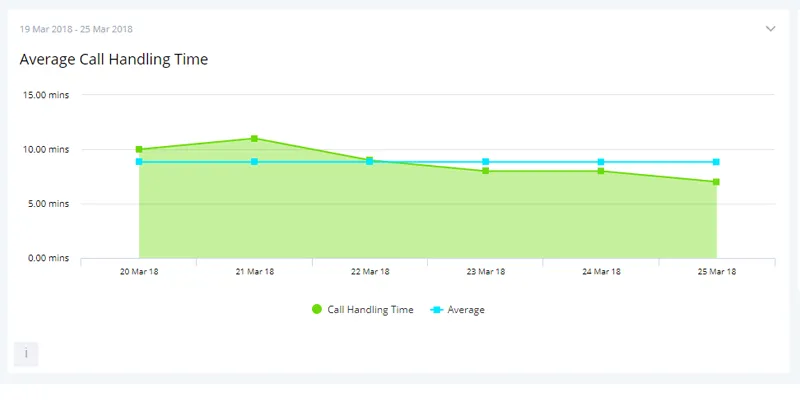
What is average call handle time?
Average call handle time is the total of all call interactions, including talk time with the customer, any time spent on hold, and the time taken to complete related tasks after the call ends. That total is then divided by the number of calls to give the average.
This is a useful KPI for understanding overall call center efficiency, tracking the performance of individual call handlers, and as a baseline for benchmarking.
Call handle time shows how quickly agents deal with inquiries, but it isn't on its own a sign of call quality. A short handle time can just as easily mean an agent is rushing through calls without providing everything a customer needs, which can drive up future call volumes or repeat contacts.
Reducing average call handling time
Reducing call handling time is a good indicator of call center efficiency. Here are a few ways to bring it down:
- Build agents' product and technical knowledge through training, so they can resolve more calls independently rather than transferring them to another department or agent.
- Build out a knowledge base that lets customers find the information they need without having to call in at all.
- Use call routing and automation on inbound calls. Getting callers to the right department or specialist quickly has a direct, positive effect on handling times.
How to calculate Call Handle Time
Add up every minute agents spend on a call, then divide by the number of calls they took: Average Call Handle Time = (Total Talk Time + Total Hold Time + Total After-Call Work) / Total Calls Handled
Total talk time is time connected to the customer. Total hold time is time the customer sits on hold or in transfer while the call is still open. Total after-call work is the wrap-up that follows: notes, CRM updates, ticket logging, follow-up emails. Total calls handled counts only calls an agent actually answered, so abandoned calls and time spent waiting in the queue sit outside this formula. Keep all four figures in the same unit, seconds or minutes, and over the same period.
A worked example
Say a team handles 800 calls in a week. Talk time across those calls comes to 4,800 minutes, hold time to 800 minutes, and after-call work to 1,600 minutes. Total handling effort is 7,200 minutes. Divide by 800 calls and average call handle time is 9 minutes, or 540 seconds.
The split is the useful part. After-call work is 2 minutes per call, a little over a fifth of the whole number. Get wrap-up down to 1 minute with better note templates and the average falls to 8 minutes, returning around 13 agent hours a week, without a single customer conversation being cut short. Track the three components as their own KPIs, not just the combined figure.
How to improve Call Handle Time
- Start with after-call work. Disposition codes, note templates and auto-populated call summaries shorten wrap-up, and it is the one component the customer never feels.
- Set targets by call type, not one number for the floor. A password reset and a billing dispute are different jobs. A single blanket target punishes whoever gets the hard queue.
- Coach the tail, not the average. Pull the longest 10% of calls and listen. It is usually a few repeating causes: a slow lookup, an approval step, one system nobody can navigate.
- Treat hold time as its own problem. Long holds mean the agent is hunting for something. A shared reference sheet or an internal escalation channel fixes that faster than any handle time target.
- Read it next to First Call Resolution. Falling handle time with falling resolution is not a win, it is work moved into next week's call volume.
What Call Handle Time does not tell you
- An average hides the shape. Nine minutes could be 200 straightforward calls and 50 that ran twenty minutes. Compare the median with the mean before you conclude anything.
- Used as a personal target, it gets gamed. Quick transfers, early hang-ups, wrap-up quietly done during the next call. The number improves and service does not. First Call Resolution is the check on that.
- A rise is not automatically bad. When self-service or a knowledge base absorbs the simple inquiries, what reaches an agent is harder and the average climbs. Read it beside Inbound Calls to see whether the mix changed.
- It says nothing about the outcome. Handle time measures effort spent, not whether the customer left satisfied. Customer Satisfaction is the counterweight that keeps it honest.
Frequently asked questions
What is a good average call handle time?
There is no single correct figure, because handle time depends almost entirely on what the calls are about. Technical support runs longer than order tracking, and neither is wrong. Set a baseline from a few months of your own data, segment it by call type, and improve against that rather than against an external number.
What is the difference between average handle time and talk time?
Talk time is only the portion of the call where the agent and customer are speaking. Average handle time adds hold and transfer time plus the after-call work that follows. Talk time alone can look healthy while wrap-up quietly consumes a fifth of the handling time.
Does after-call work count toward call handle time?
Yes. Notes, CRM updates, ticket logging and follow-up emails are all part of handling the call, so they belong in the total. Leaving them out understates the real cost per call and hides the easiest place to make a saving.
How do you calculate average handle time across a team?
Sum the talk, hold and wrap-up time for the whole team and divide by the total calls the team handled. Do not average each agent's individual average, as that weights a person who took 30 calls the same as one who took 300 and gives a misleading result.
Track Call Handle Time alongside the rest of your call center metrics on SimpleKPI's KPI dashboards, or start from the call center KPI template: one flat price for unlimited users and KPIs.