Inbound Calls KPI
Measuring all answered and unanswered calls as a performance indicator.
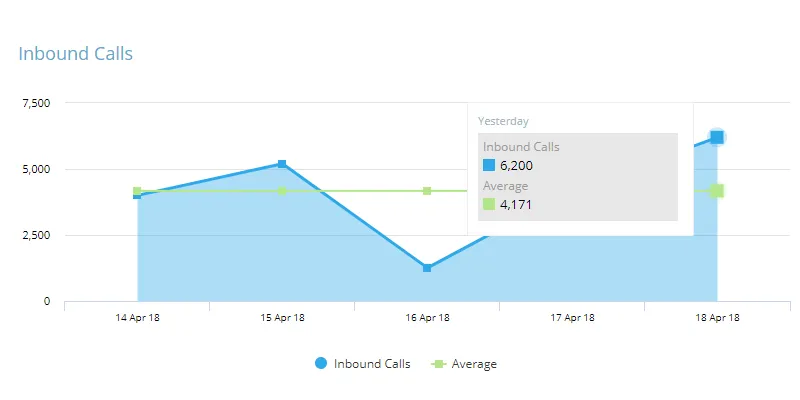
What are Inbound Calls?
Inbound calls, also known as inbound call volume, are the total number of calls made by external contacts to the call center. These calls typically relate to the product, service, or survey the organization is currently running. They're one of the easier call center KPIs to track, and include both answered and unanswered calls. Most call routing systems track inbound call volume automatically.
Inbound calls serve as the basis for many other important KPIs, such as Cost Per Call, Call Handle Time, and Call Conversions, all of which rely on this foundation KPI to calculate their values.
Measuring this KPI also offers valuable insight into resourcing a call center. The data can clearly show when the call center needs additional staff, including seasonal cycles that demand more resources to handle busy periods.
This KPI can also help identify areas of a product or service that are underperforming. A rise in call volume might suggest an issue with supporting documentation or usability, or it may simply indicate strong demand for a product or service.
How to calculate Inbound Calls
Inbound Calls is a count, not a ratio. Every call the routing system presents in the period belongs in it, answered or not: Inbound Calls = Answered Calls + Abandoned Calls.
Answered Calls reached an agent. Abandoned Calls entered the queue and disconnected before anyone picked up. The period is whatever interval you report on, half-hourly, daily or monthly, and every term has to cover the same one. Two boundary decisions are yours to make: whether a caller who self-serves in the IVR without reaching an agent counts, and whether the same person calling three times counts as three calls. Either answer works, as long as you write it down. Changing it halfway through the year does not.
A worked example
Say a support line logs 3,200 inbound calls in March: 2,940 answered and 260 abandoned. The two add back to 3,200, which is the check worth running whenever a phone report and a dashboard disagree. Over 21 working days that is about 152 calls a day.
Then split it. Mondays run near 240, Thursdays near 110. The average describes no day that actually happened. Roster to 152 and Monday drowns while Thursday idles. This KPI earns its keep at the interval you make decisions at.
How to improve Inbound Calls
- Decide which direction is good. On a sales line, rising volume is demand. On a support line, it is usually cost. Write the direction on the KPI before anyone sets a target for it.
- Tag every call with a reason. A volume number tells you nothing about what to fix. Reason codes do, and rewording one confusing billing page can remove more calls than a month of coaching.
- Cut repeat contacts. One unresolved issue can arrive as three calls. Raising first call resolution lowers volume without turning a single customer away.
- Roster to the curve, not the total. A year of half-hourly history shows the weekly shape and the seasonal peaks. Fit the shift pattern to that and the same headcount covers more calls.
- Normalize it. Track calls per 100 customers beside the raw count, so growth stops looking like a problem.
What Inbound Calls does not tell you
- It has no denominator. Volume climbs with customer count, marketing campaigns and outages alike, and the count alone cannot tell you which.
- It says nothing about whether calls got handled. Three thousand calls with 260 abandoned and three thousand with 900 abandoned are the same number here. Read it beside abandoned calls and average wait time.
- Totals hide the intervals that break. A comfortable monthly figure can contain a Monday morning where most callers waited far too long. The common 80/20 service level convention, 80 percent of calls answered within 20 seconds, is written against intervals for that reason.
- A fall is not automatically a win. Fewer calls can mean fewer problems, or a broken routing rule, a changed number, or customers who gave up.
Frequently asked questions
Do inbound calls include abandoned calls?
Yes. Inbound Calls counts every call presented to the routing system, whether an agent answered it or the caller hung up waiting. Some phone systems report calls handled instead, so check what your report counts before comparing two sources.
What is a good number of inbound calls?
There is no good number. Inbound Calls is a volume count, not a score, and the right direction depends on whether the line sells or supports. Judge it against your own history and forecast.
How do you forecast inbound call volume?
Use at least twelve months of history at half-hourly granularity, find the repeating daily and weekly shape, then adjust for known events such as billing runs, campaigns and launches. Re-forecast monthly and check the last forecast against actuals.
What is the difference between inbound calls and total answered calls?
Total Answered Calls counts only the calls that reached an agent. Inbound Calls counts those plus the ones abandoned in the queue. One measures demand, the other measures what you managed to take.
Track Inbound Calls alongside the rest of your call center metrics on SimpleKPI's KPI dashboards, or start from the call center KPI template: one flat price for unlimited users and KPIs.