Customer Satisfaction KPI
Measuring and engaging with customers more efficiently.
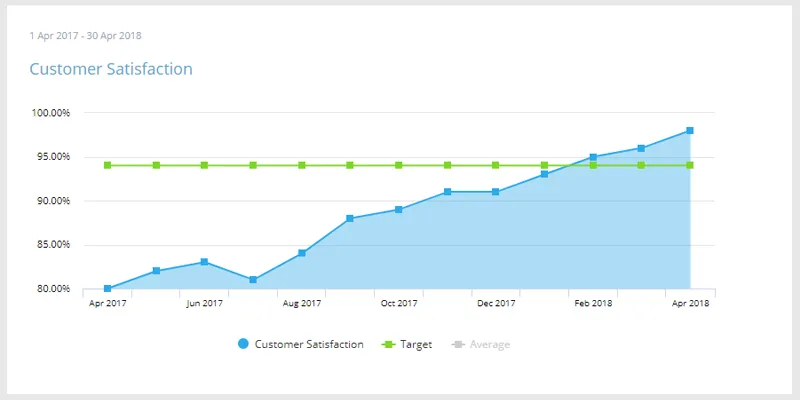
What is Customer Satisfaction?
The customer may always be right, but that doesn't automatically make them satisfied. It's clear that more satisfied customers make more repeat purchases, spread their positive experience through word of mouth and social media, and ultimately make companies more successful.
The Customer Satisfaction KPI, expressed as a percentage, gives you a high-level view of your progress across departments that handle pre- and after-sales customer care.
It works well alongside other customer-focused KPIs, such as Net Promoter Score, First Call Resolution, and Customer Effort Score.
Managing customer satisfaction closely helps you gauge whether every part of your customer engagement is meeting expectations.
How to calculate Customer Satisfaction
Customer Satisfaction, usually shortened to CSAT, is the share of survey responses that count as satisfied, shown as a percentage: CSAT % = (Satisfied responses / Total responses) x 100.
Satisfied responses are the answers at or above a cut-off you agree in advance. On a 1 to 5 scale, most teams count the 4s and 5s. Total responses means completed surveys in the period, not surveys sent. Anything ignored belongs in a separate response-rate figure. Settle the scale, the cut-off and the period once, then write all three down. Change any of them and the percentage moves without a thing changing in the business.
A worked example
Say a call center sends a one-question survey after every closed contact. In March it sends 2,000 and gets 400 back. Of those, 260 score 4 or 5, 90 score 3, and 50 score 1 or 2. CSAT is 260 divided by 400, so 65%. The response rate is 400 out of 2,000, so 20%.
Now move the cut-off. Count the 3s as satisfied and the identical month reads 87.5%. Nothing about the service changed. That's why the definition belongs on the dashboard next to the number, and why arguing over whose CSAT is higher is usually a wasted meeting.
How to improve Customer Satisfaction
- Ask while it's fresh. Send the survey within an hour of the contact closing, not the next morning. Wait a day and you get fewer replies, and more of them come from people who are still annoyed.
- Every 1 and 2 gets a human. Route low scores to a named person with a callback deadline. A complaint that gets fixed properly can still come back a 5.
- Take out the top contact reason. Tag survey comments by driver for a month, then fix the biggest one at source. The contact that never had to happen is the one you never have to score.
- Push resolution on the first attempt. Transfers and repeat contacts are a common reason a score comes back low, so First Call Resolution tends to move CSAT rather than the reverse.
- Coach on the conversation, not the percentage. A number in a monthly summary teaches an agent nothing. The same score with the call attached is something they can work on.
What Customer Satisfaction does not tell you
- The response rate decides what the score means. A 90% CSAT built on 30 replies from 1,000 contacts measures the loudest few. Publish both numbers together, every time.
- Happy respondents can sit on top of a bad queue. Customers who waited forty minutes and hung up never get surveyed. Read CSAT beside Abandoned Calls and Average Wait Time before taking a good month at face value.
- Satisfied isn't loyal. CSAT covers one interaction and says nothing about renewal. Net Promoter Score and retention answer that question. CSAT was never built to.
- Bonus on CSAT and you'll change the score, not the service. Agents who ask for a 5 tend to get more of them. Keep quality assurance scores next to it so you can tell coaching from coaxing.
Frequently asked questions
What is a good customer satisfaction score?
There is no benchmark worth quoting. A lot of teams work to somewhere in the 75 to 85 percent range, but treat that as convention rather than data, and remember it moves with the scale and cut-off you picked. Your own trend is the number that matters. Baseline over three months, then beat it.
What is the difference between CSAT and NPS?
CSAT asks how satisfied someone was with one interaction, usually straight after it happens. Net Promoter Score asks how likely they are to recommend you at all, which is a relationship question rather than a transactional one. Most teams run both.
How often should you measure customer satisfaction?
Collect responses continuously, one per closed contact, then report weekly or monthly. Daily CSAT in a small team swings on a handful of replies and reads as noise. Aggregating gives the movement enough weight to act on.
How many responses do you need before CSAT means anything?
No threshold makes a percentage true. But at ten replies one bad score moves CSAT ten points, and at a hundred it moves one, so small samples swing on almost nothing. Show the response count beside the percentage and let readers weigh it themselves.
Track Customer Satisfaction alongside the rest of your call center metrics on SimpleKPI's KPI dashboards, or start from the call center KPI template: one flat price for unlimited users and KPIs.
Related KPIs & Metrics
How to increase customer satisfaction
Increasing customer satisfaction can be the difference between an organization's success and failure. Here are a few pointers for keeping customers satisfied across every interaction:
- Use loyalty techniques such as remembering birthdays, offering early access to sales, and running loyalty card schemes.
- Set expectations from your very first communication. Avoiding overenthusiastic product claims and not overpromising builds trust and sets a more realistic level of expectation.
- Make use of email in your customer satisfaction strategy. Sending timely reminders, links to helpful resources, and feedback surveys gives customers a sense of being valued.