Call Center Expenses keeping costs under control
Track every cost involved in running your call center so you can spot where savings can be made without affecting service quality.
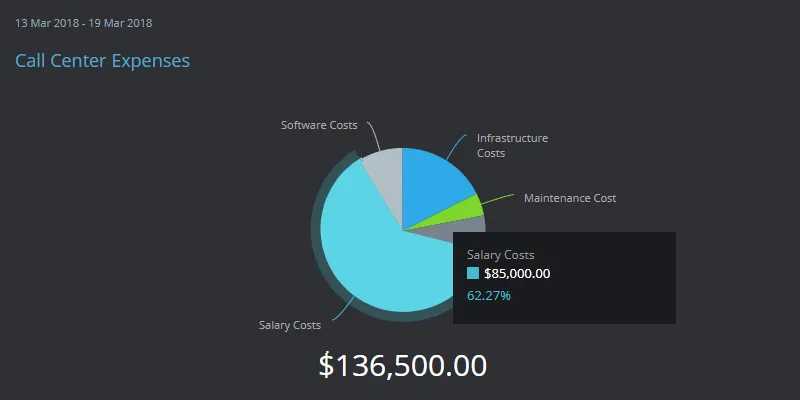
What are call center expenses?
Call center expenses are all the costs involved in operating a dedicated call center. They typically cover infrastructure, salaries and HR, training, and software, and can also include external costs such as recruitment and maintenance.
As more organizations bring call center operations in-house, the traditional scope of a call center has expanded into channels like live chat and social media, bringing additional costs with it.
Tracking these expenses gives you a clearer view of where costs are running over budget, and the detail you need if you're looking to trim or reduce them.
Reducing call center expenses
Reducing call center costs can be as straightforward as:
- Hiring through internal channels and bringing recruitment in-house.
- Investing in more capable call routing software that directs calls to the right agent as quickly as possible, reducing the number of agents needed to handle inquiries.
- Reviewing the cost of ownership of custom software and considering subscription-based tools that scale with your needs.
- Aiming to increase first call resolution, which has a direct effect on the resourcing you need.
- Scheduling more call handlers during your busiest periods.
How to calculate Call Center Expenses
Call center expenses are every cost attributable to running the call center over a defined period, usually a month: Call Center Expenses = Staff Costs + Facilities and Infrastructure + Technology and Licensing + Training and Recruitment + External Services
Staff costs are salaries, employer taxes, benefits, overtime and incentive pay for agents, team leads and support functions. Facilities and infrastructure covers floor space, power, hardware, headsets and telephony lines. Technology and licensing covers the contact center platform, CRM, workforce management and quality tools, usually billed per seat. Training and recruitment covers job advertising, agency fees, onboarding and the paid hours new agents spend before they take calls. Recruitment sits here, not under external services, even when an agency invoices it. External services covers outsourced overflow, maintenance contracts and anything else bought in. Costs shared with other departments go in at an agreed allocation percentage.
A worked example
Say a 30-seat support team closes out a month. Staff costs come to $142,000, facilities and infrastructure to $18,000, technology and licensing to $9,000, training and recruitment to $6,000, and external services to $5,000. Added together, call center expenses for the month are $180,000. The team handled 24,000 calls, so cost per call was $7.50.
The following month a hiring freeze pulls the total down to $171,000, and the finance pack reads it as a $9,000 saving. Volume fell too, to 21,000 calls, so cost per call rose to $8.14. Spend down, efficiency down. That is why this KPI is never read on its own.
How to improve Call Center Expenses
- Split the total into its five categories and track each as its own KPI. One line called call center expenses tells you the number moved. Five lines tell you which one moved, and who owns it.
- Go after the reasons people call. Pull the top five contact reasons for a month. If a confusing invoice and a missing delivery update are on the list, the cheapest fix is to the invoice and the tracking page, not to the call center.
- Buy fewer expensive hours. Overtime and agency cover are the priciest hours on any roster. Better volume forecasting, and shift patterns published a month ahead, usually cut both faster than renegotiating a rate.
- Audit per-seat licenses every quarter. Seats outlive the people they were bought for. Matching the license count to current headcount is a saving you get the same month.
- Treat attrition as a cost line. Every agent who leaves takes recruitment fees, onboarding time and weeks of reduced output with them. Track attrition next to expenses and the case for retention spending makes itself.
What Call Center Expenses does not tell you
- The total tracks volume, not efficiency. A quiet month costs less to run and proves nothing about how well the team works. Read it beside call volume and cost per call, which corrects for the work done.
- Cuts show here in weeks, damage shows elsewhere in months. Understaffing lowers this number straight away while wait times, abandoned calls and satisfaction slide later. Keep service level on the same view. The 80/20 rule, answering 80 percent of calls within 20 seconds, is a common convention worth agreeing as a floor before anything gets cut.
- Scope drift breaks the trend. Add live chat and social to the same team and the total jumps without anything getting worse. When categories or allocation rules change, record the date and compare like for like either side of it.
- Monthly totals are lumpy. Annual renewals and recruitment pushes land in a single month and distort it. A rolling three-month view shows the direction the month-end figure hides.
Frequently asked questions
What is included in call center expenses?
Staff costs, facilities and infrastructure, technology and licensing, training and recruitment, and external services such as outsourced overflow. Shared costs like building rent or central IT support go in at an agreed allocation percentage rather than in full. Write the list down once so the number stays comparable month to month.
What is the difference between call center expenses and cost per call?
Call center expenses are the total spend for a period. Cost per call divides that total by the calls handled, which takes volume out of the picture. Track both: the total answers the budget question, the per-call figure answers the efficiency one.
How often should call center expenses be tracked?
Monthly is the normal cadence, because that is how payroll and most software licenses bill. Review the total on a rolling three-month view as well, so annual renewals and hiring waves do not get mistaken for a trend.
What is a good level of call center expenses?
There is no universal figure. It depends on headcount, channels, location and whether the work is in-house or outsourced, so your own baseline over a few months is the only target worth setting against. Any benchmark SimpleKPI shows is indicative, AI-estimated rather than real peer data.
Track Call Center Expenses alongside the rest of your call center metrics on SimpleKPI's KPI dashboards, or start from the call center KPI template: one flat price for unlimited users and KPIs.