First Call Resolution KPI
Resolve customer issues on the first call to boost satisfaction and control costs.
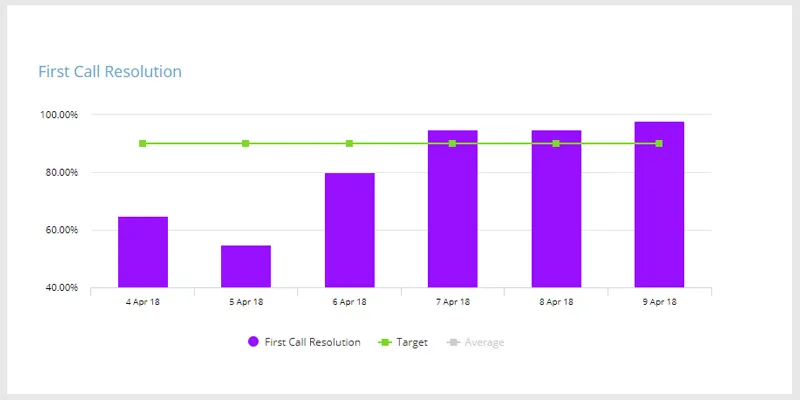
What is First Call Resolution?
First Call Resolution (FCR), also known as first contact resolution or one-touch resolution, measures the percentage of customer calls resolved in a single engagement. It's calculated by dividing the number of customer issues resolved on the first call by the total number of issues raised in the same period.
FCR matters because it benefits both the call center and the customer. The customer gets their issue resolved quickly, and the call center handles the call efficiently, resulting in satisfied customers, motivated support staff, better service, and lower costs.
How to calculate First Call Resolution
First Call Resolution is the share of customer issues closed on the first call, expressed as a percentage: FCR % = (Issues resolved on first call / Total issues raised) x 100.
Issues resolved on first call means the problem was closed during that single contact, with no callback, transfer or follow-up ticket. Total issues raised is every issue logged in the same period, counted once each rather than once per call. Both figures must cover the same period and the same queue. Fix your repeat-contact window as well: a seven-day look-back is a common convention, and it belongs in the written definition so nobody quietly changes it.
A worked example
Say a support team logs 800 issues in a month and closes 620 of them on the first call. That is 620 / 800 x 100 = 77.5%. The other 180 came back as a callback, a transfer or a second ticket later that week. The numbers are illustrative, not a benchmark.
Now change one rule. The team starts counting a warm transfer to a specialist as resolved, on the grounds that the customer only called once. Resolved rises to 700 and FCR reads 87.5%. Not one extra customer got a better outcome. That gap is the argument for writing the definition down before anyone reports the number.
How to improve First Call Resolution
- Give agents authority to close the issue. Set refund, credit and goodwill limits an agent can apply without a supervisor, because waiting on approval turns one call into two.
- Fix routing before you fix agents. Skills-based routing puts the call with someone who can solve it, and tracking FCR per queue shows where routing, not skill, is the fault.
- Code the repeat contacts. Sample ten repeats a week and record why the customer came back. That list beats the headline percentage.
- Put history on screen at answer time. Previous contacts, order status and open tickets belong in front of the agent before the call starts. Most call-backs are an agent going away to look something up.
- Review FCR and handle time in the same coaching session. Handle time read alone rewards ending calls quickly, which is exactly how first-call resolution slips.
What First Call Resolution does not tell you
- Self-reported resolution flatters the number. Where agents code their own calls resolved, they code generously. Read FCR beside Customer Satisfaction: a rate climbing while satisfaction stays flat means the coding improved, not the service.
- A phone-only count misses the other channels. A customer who gives up on the phone and emails instead never re-enters the call queue, so the rate reads better than the experience was.
- It pulls against Call Handle Time. An agent who stays on the line to finish the job pushes handle time up. Chase both without deciding which one gives, and you get short calls marked resolved.
- The average hides the queues. Say the overall rate is eighty percent: billing might sit in the nineties while technical faults sit near fifty. Those figures are made up, and that is the point. Segment before you conclude anything.
Frequently asked questions
What is a good First Call Resolution rate?
There is no universal figure, and any rate quoted without its definition attached is not comparable to yours. Baseline your own rate over a few months, then set the first target a few points above it. Kip, the AI built into SimpleKPI, can suggest an indicative benchmark, which is an AI estimate rather than real peer data.
How do you measure First Call Resolution?
Three methods are common: agent disposition codes, repeat-contact analysis over a fixed window such as seven days, and a post-call survey question. Repeat-contact analysis is the hardest to game because it reads the call log rather than an opinion.
Is first call resolution the same as first contact resolution?
The formula is identical and the two names are often used interchangeably, including at the top of this page. Where teams do separate them, first call resolution counts phone contacts only and first contact resolution covers every channel, including email, chat and self-service. Say which one your figure uses, because a phone-only rate and an all-channel rate are not comparable.
Does improving FCR reduce call center costs?
Usually, because every avoided repeat removes a full handle time and its share of cost per call. The saving is not free, since first calls often run longer, so watch cost per call alongside FCR.
Track First Call Resolution alongside the rest of your call center metrics on SimpleKPI's KPI dashboards, or start from the call center KPI template: one flat price for unlimited users and KPIs.
Related KPIs & Metrics
How to improve your FCR
Beyond reducing operational costs and improving employee and customer satisfaction, First Call Resolution is a great indicator of where staff need more knowledge or training, and where process or call-routing issues exist. It's one of the most important KPIs for a call center to track and improve. Here are a few tips to help improve your FCR:
- Monitor your most common issues and look at automating responses to the most frequent ones through a call management system.
- Build agent knowledge of your top three most frequent issues through a continuous training program.
- Feed issues about the product, service, or documentation back to the relevant team, so improvements can reduce these calls happening in the first place.