Cost Per Call KPI
Measuring the cost for each inbound or outbound call in your call center.
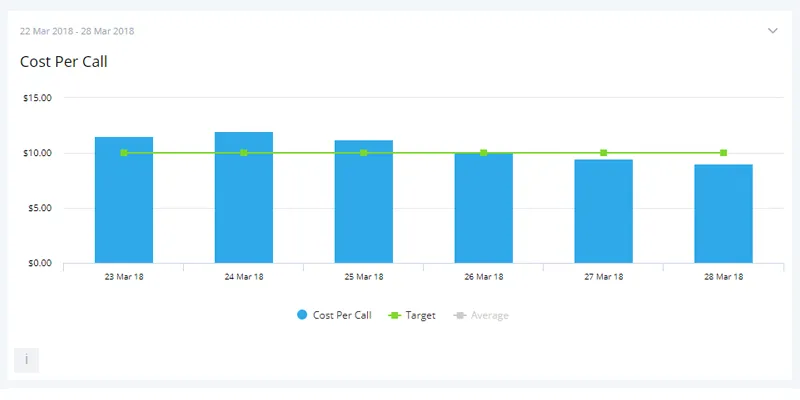
What does Cost Per Call mean?
Cost Per Call can be defined as the total cost of operating a call center divided by the number of inbound or outbound calls handled. These costs typically include infrastructure (including any leasing), salaries, utilities, software, and support services.
Although this KPI can be a good way to gauge call efficiency and costs, and assess the impact of cost on internal processes, caution is needed when using this indicator to monitor and measure employee performance. Lower call costs may not be a reliable indication of quality, so it should be used alongside other performance measures, such as call satisfaction ratings.
How to calculate Cost Per Call
Cost Per Call is the total running cost of the call center for a period, divided by the number of calls handled in that same period: Cost Per Call = Total Call Center Costs / Calls Handled. Use matching periods on both sides of the division, and calculate inbound and outbound separately if you run both.
Total Call Center Costs is everything the operation spends in the period: agent and supervisor pay plus employer costs, telephony and software licenses, premises, utilities, equipment leases, training and outsourced support. Calls Handled is the count of calls an agent actually worked in that period. Abandoned calls drop out of the denominator, but the cost of the time spent queuing them stays in the numerator.
A worked example
Say a support team spends $48,000 in a month: $36,000 on salaries and employer costs, $7,000 on telephony and software, $5,000 on premises and equipment. Agents handle 12,000 calls. Cost Per Call is $48,000 / 12,000 = $4.00.
The next month, nothing changes about how the team works, but a quiet seasonal spell drops volume to 9,600 calls. Costs are still $48,000, so the KPI reads $48,000 / 9,600 = $5.00. The number rose 25% and nobody did anything wrong. That is the shape of this measure: most call center cost is fixed in the short term, so the denominator moves it far more than the numerator does.
How to improve Cost Per Call
- Match staffing to the call curve. Idle agents and overtime both raise the cost. Forecast by half hour from your own volume history and schedule against that shape rather than a flat daily headcount.
- Chase repeat contacts, not talk time. A caller who has to ring back charges you twice for one issue. Improving First Call Resolution removes calls that should never have existed.
- Fix the reasons people call. Rank your call drivers for a month. If a confusing invoice line or a vague dispatch email is generating hundreds of calls, the cheapest fix sits in another department entirely.
- Look at after-call work. Wrap-up is often the quietest cost in the building. Pre-filled dispositions and fewer mandatory fields save seconds on every call, and seconds multiply fast.
- Break the number down before cutting anything. Cost Per Call by queue, call type and shift usually shows one or two segments carrying the whole average. Cutting broadly when the problem is narrow just moves cost somewhere else.
What Cost Per Call does not tell you
- It falls when volume rises, whatever the team does. Fixed costs spread across more calls. A busy month flatters you and a quiet month indicts you, so always read it beside call volume.
- Cheap calls reappear as callbacks. Rushing a caller off the line lowers this month's figure and raises next month's volume. If cost drops while First Call Resolution slips, you moved the cost, you did not remove it.
- The denominator hides the calls you lost. Abandoned calls consume queue capacity and never reach the count, which can make an understaffed month look efficient. Watch abandonment and answer speed alongside.
- Comparing across companies rarely holds. Two operations counting different cost lines produce different numbers for identical work. Your own trend on a stable definition is the comparison worth trusting. Indicative benchmarks in SimpleKPI are AI estimates for sanity checking, not peer data.
Frequently asked questions
What is a good cost per call?
There is no universal figure, because it depends on wage levels, call complexity and how much of the operation you count. A two-minute order status call and a thirty-minute technical fault sit nowhere near each other. Baseline your own data over a few months, then judge yourself on the trend.
What costs should be included in cost per call?
Everything it takes to keep the lines open: agent and supervisor pay including employer costs, telephony and software, premises, utilities, equipment and training. The important part is deciding once, writing the definition down, and not changing it mid-year. A quietly widened cost base looks exactly like a performance problem.
Is cost per call the same as cost per contact?
No. Cost per contact spans every channel, so calls, email, chat and social all share one denominator. Cost per call covers voice only. Keep them apart, otherwise a twelve-minute phone call and a two-minute chat get averaged into a number that describes neither.
How often should you measure cost per call?
Monthly suits it best, because payroll and most licenses land monthly and the denominator has time to even out. Weekly readings are noisy enough to trigger the wrong decisions. A common split is monthly for operations and quarterly for the board.
Track Cost Per Call alongside the rest of your call center metrics on SimpleKPI's KPI dashboards, or start from the call center KPI template: one flat price for unlimited users and KPIs.
Related KPIs & Metrics
Reducing Cost Per Call
Once you've calculated your cost per call over a set period, you can take some practical steps to reduce it, such as:
- Use skill-based routing so a caller's query or issue is handled by the right agent the first time.
- Coach and train your agents regularly, giving them the skills to handle calls as efficiently as possible.
- Invest in integrated call center software and computer telephony integration (CTI), alongside self-service tools that let customers complete tasks like bookings, purchases, or paying invoices on their own.