Service Level KPI
Tracking the efficiency of your call center by measuring how quickly calls are answered.
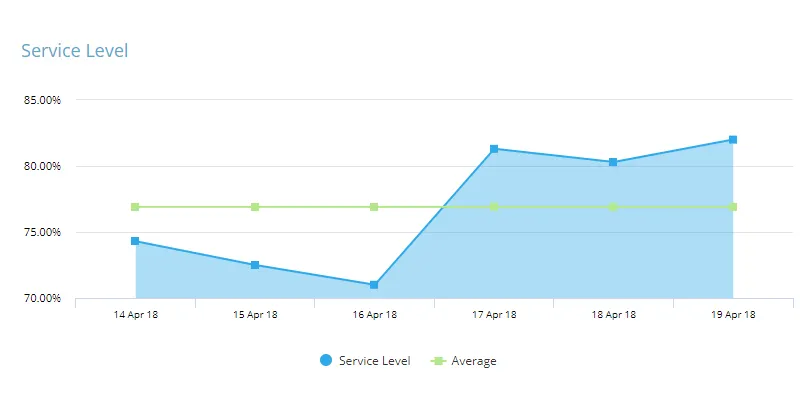
What is Service Level?
Service level, also known as service grade, is the percentage of calls into the call center answered within a set threshold. This threshold is usually short, since the longer a call goes unanswered, the higher the abandonment rate. A threshold of 30 seconds or below is typical for call centers.
This KPI is a useful indicator of staff efficiency, and provides insights that help you deploy more call handlers during busy periods and fewer during quiet ones.
How to calculate service level
Service level is calculated by dividing the number of calls answered within the threshold by the total number of inbound calls (including abandoned calls), then multiplying by 100 for a percentage.
How to calculate Service Level
Service level is the calls answered inside your threshold divided by every call that arrived, as a percentage: Service Level % = (Calls Answered Within Threshold / Total Inbound Calls) x 100. Threshold and target are quoted together, which is where the common 80/20 shorthand comes from: 80 percent of calls answered within 20 seconds.
Calls answered within threshold means calls connected to an agent with a queue wait at or under the threshold, timed from when the call joins the queue, not from when it reaches your phone system. Total inbound calls means every call that entered the queue, including those abandoned before anyone answered. Leaving abandons out flatters the result, so fix the rule once and write it beside the KPI.
A worked example
Say a team takes 800 inbound calls in a week against a 20 second threshold. Of those, 620 were answered inside 20 seconds and 60 callers hung up before an agent reached them. Service level is 620 divided by 800: 77.5 percent. Short of the 80 percent convention, but not by much.
Now drop the abandoned calls from the denominator. 620 divided by 740 gives 83.8 percent, and the same week clears the same convention. Nothing changed except the counting rule, which is why the denominator matters more than the threshold.
How to improve Service Level
- Forecast in half hour intervals, not daily totals. A day averaging 82 percent can still hide a 9am hour down in the forties. Staff the interval, not the day.
- Stagger breaks, lunches and team meetings. Service level drops hardest when several agents step away at once, so schedule adherence beats headcount as a first move.
- Cut after call work. Every second spent wrapping up is a second the agent is not taking the next call. Note templates buy back queue capacity without hiring.
- Leave slack in occupancy. Occupancy is the share of logged in time agents spend on calls. A queue run close to fully occupied has nothing left to absorb a spike, so planners usually hold some headroom back rather than staffing to the last percent.
- Offer a callback once the wait passes a set point. It keeps the caller without keeping them on hold. Decide first how it counts in the formula.
What Service Level does not tell you
- A period average hides the intervals that failed. A month at 80 percent built from calm afternoons and grim Monday mornings is not an 80 percent experience for Monday callers.
- It measures the answer, not the outcome. A call picked up in 12 seconds and resolved badly returns tomorrow as another call. Read First Contact Resolution beside it.
- It ignores the callers who left. Pair it with Abandoned Calls, which shows how many gave up and when. That is the same population your denominator is arguing about.
- It can be met without helping anyone. Answering fast and then transferring or parking the caller still counts as answered, so keep satisfaction and handle time in view.
Frequently asked questions
What is a good service level for a call center?
The common convention is 80/20: 80 percent of calls answered within 20 seconds. It is a habit rather than a law. Sales lines and technical help desks have fair reasons to sit either side of it.
What is the difference between service level and average speed of answer?
Service level is a percentage measured against a threshold. Average speed of answer is the mean wait across all calls. A healthy average can hide a tail of callers waiting minutes.
Do abandoned calls count in service level?
In the standard reading, yes. They sit in the denominator, because a caller who gave up was not served. A common convention is to exclude abandons inside the first few seconds, on the grounds that they are misdials. Whichever rule you pick, write it down and stick to it.
How often should service level be measured?
Half hourly to run the floor, daily to spot patterns, monthly to report. Use one threshold at every level or the numbers will not reconcile. SimpleKPI holds all three views, since dashboards and KPIs are unlimited.
Track Service Level alongside the rest of your call center metrics on SimpleKPI's KPI dashboards, or start from the call center KPI template: one flat price for unlimited users and KPIs.
Related KPIs & Metrics
How to improve service level
Improving service level should be a high priority for call centers. Since service quality has a big impact on revenue, it's important to measure and optimize the processes that directly affect this KPI. Here are a few things you can do to improve your service level:
- Use historic data to identify patterns in call volume, helping you resource more efficiently. Combine this with external factors, such as a new promotion, product launch, or event, to make sure you have enough call handlers on hand.
- Take steps to improve First Call Resolution, such as routing calls to agents with the right knowledge to answer the query, and providing automated information channels to reduce repeat calls from the same customer.
- Expand your support channels by using other mediums, such as social media, automated website support, and live web chat where applicable.