You've had fewer injuries and lost fewer workdays, and then your workers' comp renewal comes in higher than last year. So what's going on?
It does happen, and I'd start by checking the dates. Your safety dashboard might be showing you the last 12 months, while part of your renewal is based on claims from a few years back. Both numbers can be right. They're just telling you about different years.
You probably already have the numbers that explain it. They're just in three different places. Safety has the injury log, finance has the premium, and your broker has the claims history. Put those side by side and it's much easier to see what's driving this year's bill and what might change at the next renewal.
It's worth doing now. NCCI generally works out the experience mod 60 to 90 days before the policy renews, so if yours renews on January 1, it's probably being put together right about now.
So let's go through which years are in your renewal, what a change in the mod costs in dollars, and the five KPIs I'd put on a monthly report. There's a calculator to try your own numbers on the way, and a spreadsheet at the end.
Which years are in your renewal?
The experience mod is a number used to adjust your workers' comp premium based on how your claims compare with what's expected for a business doing similar work. For the part of your premium it applies to, a mod below 1.00 brings the cost down and a mod above 1.00 pushes it up.
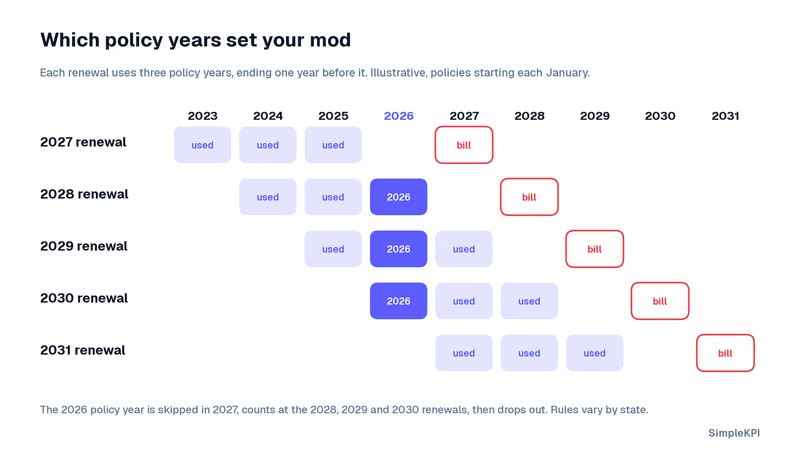
The useful bit to understand is when a claim gets into that calculation. Under NCCI's experience rating plan, which most states use, the mod uses three years of experience and leaves out the most recent policy year. Here's what that can look like for a claim on a policy that started January 1, 2026.
| Renewal | What happens to the 2026 claim? |
|---|---|
| 2027 | It isn't in the mod yet. |
| 2028 | It's included for the first time. |
| 2029 | It's still included. |
| 2030 | It's included for the last time in this example. |
So if 2026 was a bad year and 2027 was much better, the 2028 renewal can pick up the bad year before it picks up the better one. That doesn't mean your safety improvements didn't work. It means they're not in that calculation yet.
Rules vary by state, and California, New York, Pennsylvania and a few others have their own rating bureaus, so use the dates as an example and ask your broker which policy years apply to you. Smaller businesses may not have a mod at all, because each state sets a minimum premium before experience rating applies.
It isn't always the mod, either. Rates, payroll and class codes move the premium too, so the broker questions further down cover those as well.
Tip: Ask which year drops out next, too. It's easy to focus on the claims coming in and forget that a difficult year might be on its way out.
What does a change in the mod actually cost?
Let's keep the math simple. Say you have $300,000 in annual premium before the mod is applied. At 0.90, that comes to $270,000. At 1.20, it's $360,000. So if everything else stays the same, the difference is $90,000 for that renewal.
That's the number I'd put in front of finance. A mod of 1.20 on its own doesn't tell you how much to budget. The dollar difference does.
And if you want to see what that costs the business in sales, try putting your profit margin next to it. At a 5% margin, it takes $1.8 million in extra sales to cover $90,000 in extra cost. That's an illustration, not a forecast, but it makes the difference a lot easier to picture. OSHA's $afety Pays estimator does the same sum for the cost of an injury.
What's a change in your mod worth?
Why the number of claims matters as well as the cost
Here's a good example from NCCI. Take two similar businesses. One has a single $50,000 claim. The other has ten claims adding up to $50,000. Same total, but the business with ten claims will generally face higher future costs under experience rating.
That's because the calculation gives more weight to the first portion of each claim than to the dollars above it. Medical-only claims count for less: in all but two NCCI states, only 30% of a medical-only claim goes into the mod. So if your report only has one line for "total claims cost," you're missing both how often claims are happening and what kind they are.
The five workers' comp KPIs I'd start with
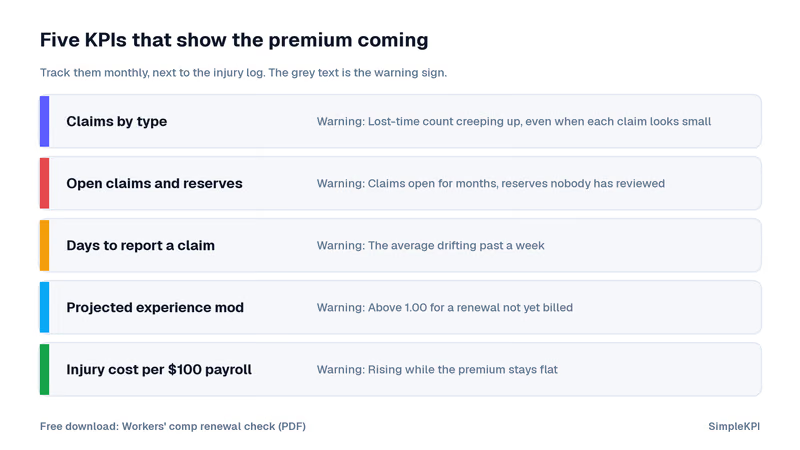
You don't need a dashboard full of charts for this. Start with these five and give each one a job.
| KPI | What to track | What to do if it moves |
|---|---|---|
| Claims by type | Monthly counts of medical-only and lost-time claims, shown separately. | If lost-time claims creep up, look for repeat injuries, tasks, or locations rather than just reviewing the largest claim. |
| Open claims and reserves | What's been paid and what the insurer has set aside for future payments. | If a reserve jumps or hasn't been reviewed in months, ask the adjuster what it's based on and whether anything has changed. |
| Days to report a claim | The time from the injury to when it's reported to the insurer. | If reports start taking longer, find out where they're getting held up. |
| Projected experience mod | Your broker's estimate for upcoming renewals, alongside the estimate you used for your budget. | If it moves, ask which claims or policy years explain the change. A rise from 0.75 to 0.95 is still worth a look, even though it's below 1.00. |
| Injury cost per $100 of payroll | Premium plus the uninsured injury costs you track, divided by payroll and multiplied by 100. | If it rises while the premium stays flat, check what you're spending on things like overtime or covering shifts. |
Days to report is on the list because late claims cost more. Liberty Mutual's claim reporting lag study, on its larger customers' claims from 2016 to 2018, found that claims reported 29 days or more after the injury cost 52% more on average than those reported within three days. It suggests aiming for 80% reported within three days.
The uninsured costs are the ones the premium never shows: overtime to cover the shift, training a replacement, the time spent on the investigation. OSHA's $afety Pays background puts them at between 1.1 and 4.5 times an injury's direct cost, depending on how big the claim is, and is clear that those are general estimates.
If you only have time to set up one view, put this month's claims next to the projected mod. One shows what's happening now. The other gives finance something to work with before the renewal turns up.
We used a made-up Midwest bakery in our health and safety dashboard example. Lost workdays fell from 268 in one year to 66 the next. That improvement would be easy to see on the dashboard. What you wouldn't know from the chart alone is when, or by how much, the insurance bill might change. If it were a real business, its worse year would still be in the mod for renewals to come, even as the dashboard showed things getting better. That's where the broker's projection earns its place on the report.
What I'd ask the broker before renewal
Start with the loss runs. That's the insurer's claims history, showing what's been paid and what's still reserved. Then go through these questions:
- Which policy years are in our current mod, and which one drops out next?
- What's our projected mod, and which claims are making the biggest difference?
- Which claims are still open, and when were their reserves last reviewed?
- Has anyone returned to work without that change being reflected in the claim estimate?
- How are medical-only claims treated in our state?
- Are our job classification codes and payroll figures right?
- What would the premium be at a mod of 1.00, with everything else held the same?
Tip: Ask what date your claims will be valued at for the next mod. That gives you a date to work back from instead of leaving the claims review until the renewal meeting.
Try it with your own numbers
Start with the Excel calculator. Put in your payroll, rate, current mod, and projected mod to see what the difference could mean in dollars. It also has a 12-month tracker for the five KPIs. If you're heading into a broker meeting, use the one-page renewal checklist to keep the dates and questions handy.
- Experience mod cost calculator (Excel): your payroll, rate, current mod and projected mods for the next three renewals, what they cost and the sales it takes to cover them, the uninsured costs of each claim, and a 12-month tracker for the five KPIs.
- Workers' comp renewal check (PDF): the renewal timeline, the five KPIs with their warning signs, the broker questions and a quarterly check, on one page.
Once you know which numbers you want to keep an eye on, you can set them up in SimpleKPI and schedule a monthly report for finance and safety. If you haven't used SimpleKPI yet, you can try it free for 14 days and build the report as you go.
Next time the renewal goes up after a safer year, check which years are in the mod before you decide what the increase means. It's a quick question for your broker, and it gives you a much better place to start.

Because the experience mod uses older claims. Under NCCI's plan, the mod uses three policy years ending one year before the renewal, so a safer year isn't counted until the renewal after next, while a worse earlier year can still be in. Rates, payroll and class codes can move the premium too.
A multiplier on your workers' comp premium that compares your claims with the average employer doing similar work. Below 1.00 is a credit, above 1.00 is a debit. NCCI's example: a $100,000 premium becomes $75,000 at 0.75 and $125,000 at 1.25.
Under NCCI's plan, usually three renewals. The mod uses three policy years ending one year before the renewal, so a claim on a policy starting in 2026 first counts at the 2028 renewal and last counts at 2030. Rules vary by state.
Yes, but less. In all but two NCCI states, only 30% of a medical-only claim counts, a rule NCCI introduced in 1998 so employers wouldn't pay small claims out of pocket.
Claims by type, open claims and what's reserved, days to report a claim, projected experience mod for the next three renewals, and injury cost per $100 of payroll.
Turn KPIs like these into live production dashboards, and pay one flat price: $79 a month for unlimited users and KPIs. There is a 14-day free trial, no card needed.