Dig out what you're paying for your online software subscriptions. All of them. Go on, I'll wait.
Now compare it with the same list a year ago. You're bound to see increases. Some will be plain price rises. Some will be a tier that quietly got more expensive. And on at least one of them there's probably a line that wasn't there before. It might say "credits." It might say "agent outcomes" or "consumption."
Try to answer one simple question: what does one of those units actually buy you? If you can't, don't feel bad. HubSpot's own pricing page now has three layers to it, and Salesforce changed what it was charging for three times in under a year.
That question is the reason for this post.
Meanwhile, Satya Nadella went on the BG2 podcast and said the notion that business applications exist will "collapse" in the agent era. He said it quite calmly, as if he were predicting rain. His company charges $30 a user a month for Copilot, and then meters the AI on top.
So here's the brutal truth. Per-seat pricing is on its way out. The vendors are the ones killing it, and the smartest of them see it as a chance to cash in.
The sneaky replacement is the AI meter. The vendor owns the meter, sets the unit, and in many cases won't tell you what one unit buys. And the cleverest vendors aren't replacing the seat at all. They're keeping it, and adding the meter on top.
None of this is happening in the name of clarity. It's murky by design, and murky is exactly the condition a meter you don't control works best in.
The dark side of seat pricing
Ah, the seat license. Let's face it, nobody other than your vendor ever loved it.
You paid for the person in accounts who logged in twice a year. You paid for the contractors who left in March and still had logins in November. Zylo's 2026 SaaS Management Index puts unused paid licenses at 36%. Think about that for a second: more than a third of the bill buys nothing at all.
Vendors were perfectly happy with this, because headcount only ever went one way. Your company grew, your seat count grew, their revenue grew. Nobody had to have an awkward conversation.
It was a business model built on a single assumption: that you would keep hiring people.
Then two things happened at once. Companies started cutting licenses. Vendr called 2024 the "Year of the Descope", with every quarter's contract values coming in below 2023 and inflation-adjusted software spending down 7 to 8%. And AI agents showed up, promising to do the work of the people those seats were for.
So if your pricing is based on the number of humans, and your own sales pitch is "fewer humans," well, you have a problem.
Your SaaS vendor saw it coming. Their answer? Charge you twice.
What buyers think changed first
Earlier this year we surveyed software buyers for a piece called The Predictability Problem. I'll be honest, the headline finding surprised me.
Cost has overtaken security as the thing people worry about most. Thirty-two percent named ongoing subscription cost as the biggest drawback of SaaS, against 22% for security. Three quarters judge software by money made or time saved, not by the feature list.
And here's the part that should worry you: half only check what they're actually using when the renewal lands.
Cost, not security, is now the biggest perceived drawback of SaaS
Selected findings from The Predictability Problem, SimpleKPI Research 2026. Base: 50 respondents.
- Ongoing subscription cost is the biggest drawback32%
- Security is the biggest drawback22%
- Judge software by revenue or time saved74%
- Only review usage at renewal or later50%
Source: The Predictability Problem, SimpleKPI Research 2026.
The wider market says the same thing. G2's 2026 buyer report found finance involvement in software decisions jumped from 31% to 46% in a single year, and 49% of buyers say their CFO vetoed a purchase that had already been approved. Seventy percent say the pace of AI innovation is pushing them toward shorter contracts. Battery Ventures found contracts of 25 months or more have fallen from 64% of deals historically to 29% today.
Zylo says 79% of IT leaders saw a price rise at renewal in the past year, and expensed SaaS spend, meaning software put on a company card rather than bought through procurement, rose 267% year on year. The most expensed app across Zylo's customer base right now? ChatGPT.
So what do buyers want? They want to know the number before the year starts. Keep that in mind, because it's the one thing the new pricing models can't give you.
Seat licensing is being dismantled by the vendors themselves
Don't take my word for it. Here's the timeline so far.
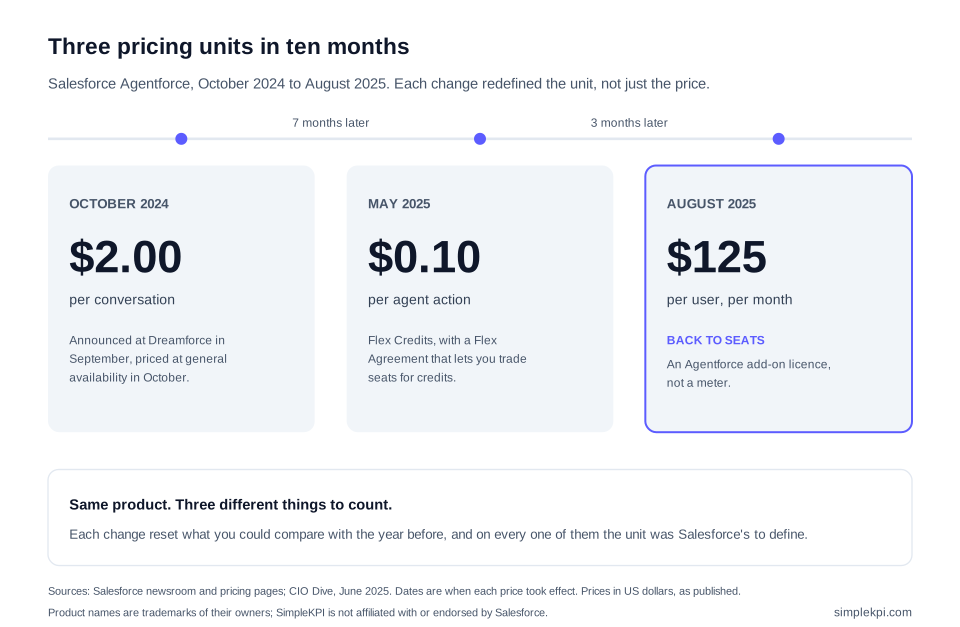
May 2025: Salesforce launches Agentforce Flex Credits at $0.10 per agent action, with a "Flex Agreement" that lets you trade seats for credits.
Early 2026: Microsoft puts Copilot Cowork, the agent that actually does tasks, on a meter, on top of the $30 Copilot seat. Microsoft prices a credit at a cent and publishes illustrative task bands: 70 to 200 credits for a light task, 400 to 600 for a medium one, more than 1,500 for a heavy one. That's roughly $0.70 to $2, $4 to $6, and north of $15, per task, on top of the seat.
June 2026: GitHub Copilot moves from a flat fee to usage billing at the same sticker price. The price tag is unchanged. The bill isn't.
HubSpot now has three layers in one contract: seats, agent outcomes, and credits. Atlassian is openly discussing overage charges for Rovo.
The analysts agree. ICONIQ's State of AI 2026 report has consumption pricing rising from 35% to 42% of AI products in six months, and outcome pricing from 18% to 23%. Maxio, which sells billing software and therefore has a horse in this race, finds hybrid seat-plus-usage vendors growing fastest at a 21% median. IDC expects pure seat-based pricing to be obsolete by 2028, with 70% of vendors refactoring their pricing around consumption, outcomes or organizational capability.
Metered pricing gained seven points in six months
Share of AI products using each pricing model.
- Consumption pricing, six months ago35%
- Consumption pricing, now42%
- Outcome pricing, six months ago18%
- Outcome pricing, now23%
Latest readingSix months earlier
Source: ICONIQ, State of AI 2026.
The stock market got there first. When Anthropic released Claude Cowork plugins on January 30 this year, the S&P Software & Services index dropped 4% the following week, more than $285 billion of market value in a single day. By late February it was down 25% from where it stood on January 12. People called it the SaaSpocalypse.

Now, is "dead" an exaggeration? A little. "Dead" is the headline. "Plummeting" is the data.
High Alpha's 2025 benchmark still had 53% of companies monetizing their AI on a plain subscription, with 31% hybrid, 11% usage-based and 5% outcome-based. Salesforce even went back to a seat-based AI license in 2025 after customers refused to sign blank checks. But look at the direction and the speed. Consumption pricing gained seven points in six months. Every major vendor launch this year has come with a meter attached.
The seat isn't being switched off. It's being hollowed out, one renewal at a time, and the pace is picking up fast.
The double charge: seats for the humans, credits for the robots
This is the part I'd really like you to notice, because it's the part that will cost you.
The smart move for a large vendor isn't to drop the seat. It's to keep the seat and add a meter right beside it.
Look at the Microsoft structure: $30 a user a month for Copilot, then Cowork credits on top. HubSpot: seats, plus agent outcomes, plus credits. Salesforce: seats for the humans, Flex Credits for the agents, and a $125-a-user AI license for anyone who wants a fixed number. Atlassian bundles more Rovo credits into its bigger tier, so the meter nudges you up the price list instead of billing you directly.
Now think about what this does as your team gets smaller.
AI is supposed to mean fewer people doing the same work. So seat revenue falls. The vendor needs something to replace it, and the meter is that something. Every task the AI does instead of a person is a task that used to be free inside a seat and is now billed by the unit.
The headcount shrinks. The bill doesn't. In a lot of cases the bill actually grows, because the agent does more than the person did and every single action counts.
The economics explain why. Classic SaaS runs at roughly 70 to 80% gross margin. AI features don't. Every agent action costs compute, and the Growth Unhinged 2026 monetization survey found the median vendor is only targeting a 50% margin on AI. Just 12% think they can get back to 80%. So 29% of vendors already sell AI credits and another 33% plan to.
Why the meter is going on: AI margins, and who is billing for them
Vendor-side economics behind the shift from seats to credits.
- Classic SaaS gross margin70-80%
- Median target margin on AI features50%
- Vendors expecting to reach 80% again12%
- Vendors already selling AI credits29%
- Vendors planning to sell AI credits33%
Source: Growth Unhinged 2026 monetization survey.
Every credible estimate of how much work agents can absorb runs into the tens of percent of a typical business function. If the seat base shrinks by anything like that, the meter has to carry the revenue.
Salesforce put it plainly. On its December 2025 earnings call, president and COO Miguel Milano told analysts the agentic shift gives Salesforce "three times, four times the ability to multiply the monetization on customers."
That's the plan, stated out loud: charge for the people while you have them, charge for the robots as they replace them, and never, ever let the total fall.
I don't envy the vendors this problem. Inference costs are real. But there's a big difference between an agent firing off thousands of actions a day across a CRM and an assistant that builds your dashboard, spots an anomaly and explains what moved. The first is expensive to give away. The second isn't, if you design for it, and I'll come to how we do that.
The big vendors chose the expensive kind, and then chose to make you carry the risk. They call it flexibility.
Smaller teams, bigger bills: who the vendors really answer to
There's one more reason the meter is going on, and it has nothing to do with you.
Most large SaaS companies were funded and valued on a story about headcount. Seat-based revenue that grew every year as customers hired, with net revenue retention above 100% as the proof. Investors paid for that story, and they still expect it.
Meritech put median net dollar retention for public software at 107% in February 2026, its lowest point in years. Jamin Ball's Clouded Judgement has the median public software company at a 2% operating margin, roughly break-even, even while free cash flow margin sits at 21%.
So they're in no position to let revenue per customer fall, whatever AI does to the cost of serving that customer.
And AI is doing a lot to that cost. Marc Benioff said in December 2024 that Salesforce would hire no new engineers in 2025 because of a 30% productivity gain from its own agents. By September 2025 he'd cut customer support from 9,000 people to 5,000, because, in his words, "I need less heads."
Workday cut about 1,750 jobs, roughly 8.5% of its people, to fund its AI investment. Microsoft held headcount flat at 228,000 through the year to June 2025 while revenue grew, and Nadella said hiring would grow "with a lot more leverage than the headcount we had pre-AI." Challenger, Gray & Christmas counted nearly 55,000 US job cuts in 2025 attributed directly to AI. ICONIQ found software companies that lean hardest on AI run 21 to 43% fewer go-to-market staff for the same revenue, depending on their size.
So the vendors' own teams are shrinking. Their costs of selling to you and supporting you are falling. You'd think some of that would show up in your price, right?
But nope. That's not what happens.
SaaS prices are rising several times faster than consumer prices
Annual increase, SaaS list prices against consumer inflation.
- SaaS price inflation (Vertice index)13.2%
- G7 consumer inflation, same period~1/5th
- Salesforce list price rise, Aug 20256%
- Adobe Creative Cloud Pro17%
- Slack Business+20%
Bars are scaled to the largest value shown, 20%. Vertice reports SaaS inflation at nearly five times G7 consumer inflation. Sources: Vertice SaaS Inflation Index 2026, vendor pricing pages and announcements.
Vertice's SaaS Inflation Index has prices rising 13.2% a year, nearly five times consumer inflation across the G7, and 60% of vendors deliberately masking rises during negotiation. Salesforce added an average 6% to its list prices from 1 August 2025, announced in June alongside its new Agentforce add-ons and justified as "ongoing innovation and customer value" rather than named on AI. Microsoft 365 goes up between 5% and 16% from July 2026 across the mainstream suites, and as much as 43% on frontline SKUs, with Copilot Chat bundled in whether you wanted it or not. Adobe's Creative Cloud Pro migration raised prices about 17%. Slack Business+ went up 20%, from $12.50 to $15.
Let's be fair about one thing. AI does add a real cost that old SaaS didn't have. Every agent action burns compute, and that's not nothing. But it doesn't explain a 13% price rise on products that haven't changed, and it certainly doesn't explain why a vendor that needs fewer people to serve you is charging you more.
What explains that is the investor on the other end of the phone, who bought a growth story and wants it kept.
Smaller teams on their side. Bigger bills on yours. That's the deal, and nobody's going to say it out loud at the renewal meeting.
The feature tax: paying again for things you thought you had
There's a quieter trick that runs alongside the meter, and you've probably paid it without noticing.
It's charging separately for individual features. Sometimes they're features that used to be in the box. Sometimes they're things any reasonable buyer would expect to be there. Either way, the base price stays put and the bill grows.
The best-known example is the "SSO tax." Single sign-on is a basic security feature, and a whole website, sso.tax, exists to list the vendors who lock it behind their top tier. GitHub's Team plan is $4 a user; the tier with SAML is $21. Atlassian sells SSO, user provisioning and audit logs as a separate product called Guard, from $4.20 a user a month on top of whatever you already pay. HubSpot puts full account SSO in Enterprise, so on Marketing Hub you go from a $7 Starter seat to an Enterprise contract starting at $3,600 a month.
Then there's unbundling. In 2024 Microsoft pulled Teams out of Microsoft 365 and sold it back separately; Forrester called it "a sneaky price hike" and worked out that buying both cost about $3 a user more than before. GitHub split its security product into two SKUs. Zendesk still sells its agent-assist AI as a $50-an-agent-a-month add-on, and charges separately per automated resolution for the AI that faces your customers. Zoom's fuller AI tier was a $12 add-on until June 2026, when ZoomMate replaced it for new buyers at $20 a user. Salesforce's Agentforce add-on starts at $125 a user.
And when vendors go the other way and "bundle" AI into the base tier? Check the price. Google Workspace folded Gemini in and put Business Standard up from $12 to $14. Slack dropped its AI add-on and raised Business+ from $12.50 to $15. Canva cited its AI features when it took a five-person Teams plan from $120 to $500 a year.
Vertice says 27% of vendors used straight shrinkflation in the last quarter: fewer seats, lower caps or features removed, at the same price. Zylo found 77% of IT leaders hit unexpected costs after the contract was signed.
Seat, meter, feature. Three dials, and the vendor has a hand on all of them.
What a click costs, and why you can't budget for it
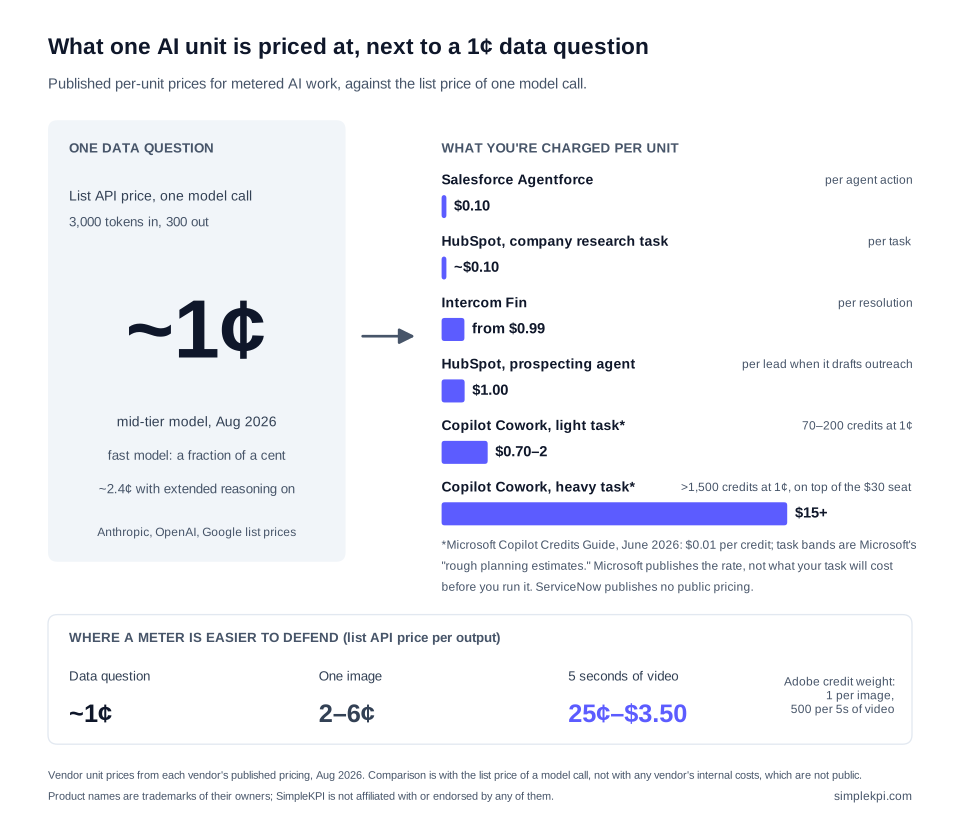
So what does a click actually cost? Ten cents for a Salesforce agent action. Intercom charges from $0.99 per Fin outcome, its word for a resolution. A light Copilot Cowork task runs about $0.70 to $2 on Microsoft's own illustrative bands, and a heavy one more than $15, on top of the seat.
What one unit costs, when the vendor will tell you
Published per-unit prices for metered AI work. Bars scaled to $15.00.
- Salesforce Agentforce, per agent action$0.10
- Intercom, per resolutionfrom $0.99
- HubSpot, per lead recommended$1.00
- Copilot Cowork, light task$0.70-2
- Copilot Cowork, medium task$4-6
- Copilot Cowork, heavy task$15+
- A typical analytics question, in tokens~$0.01
Copilot Cowork bands are Microsoft's own illustrative per-task credit ranges at its published one cent per credit, which Microsoft calls "rough planning estimates"; they sit on top of the $30 per user per month seat. The analytics figure is the list API price of the tokens, roughly 3,000 in and 300 out, not any vendor's cost to deliver an action. Sources: vendor pricing pages; Microsoft Copilot Credits Guide, June 2026.
Microsoft publishes the credit rate and a set of illustrative bands, but no fixed price for the task you are about to run. ServiceNow publishes no list pricing at all, so its consumption rates reach you through an account team or not at all. Either way, you find out what a task cost after it has run.
NPI Financial modeled a 150-user Copilot rollout and found consumption adds about 75% to the license cost at moderate use, and overtakes it if usage doubles. Adobe cut new Single App subscribers from 500 generative credits a month to 25, and when you run out the premium feature is walled off until they reset or you buy more.
Adobe's case is at least understandable. Images and video are the expensive end of AI. On Adobe's own credit table a standard image costs 1 credit and five seconds of 1080p video costs 500. At public API prices a mainstream image runs 2 to 6 cents and a five-second clip anywhere from 25 cents to $3.50.
Data is the other end of the scale, and it happens to be the thing AI is best at. A typical analytics task, say 3,000 tokens of context and a 300-token answer, is priced at a fraction of a cent on a fast model and about a cent on a mid-tier one. That's the list price of the tokens, not what it costs a vendor to wrap them in a product, and a16z reckons the cost of a fixed quality level falls roughly ten times a year.
Here's the jaw-dropping part. When a data or CRM vendor puts a meter on AI, that meter is priced against the value of the outcome, not the cost of the tokens. The meter is the product.
Put that next to the buyer data. Half of companies only check usage at renewal. So it's no surprise that Zylo found 78% of IT leaders have been hit with unexpected AI or consumption charges, and 61% have cut projects because of unplanned SaaS costs.
A Mavvrik survey found 40% of enterprises had escalated surprise AI costs to the board, and a third had imposed emergency spending freezes.
The bill shock is already widespread
Share of companies reporting each outcome.
- Hit by unexpected AI or consumption charges78%
- Hit by unexpected costs after signing77%
- Faced a price rise at renewal79%
- Cut projects over unplanned SaaS costs61%
- Escalated surprise AI costs to the board40%
- Imposed an AI spending freeze33%
Sources: Zylo 2026 SaaS Management Index; Mavvrik enterprise AI cost survey.
The Salesforce story is worth keeping an eye on. Agentforce launched at $2 a conversation in the autumn of 2024. Seven months later it was $0.10 an action. Three months after that it was $125 a user a month, back on seats, because customers hated not knowing.
Three pricing units inside a year, and on each change the unit was the vendor's to define. You don't get a vote.
Outcome pricing, the newest idea, has the same catch. Zendesk and Intercom charge per "resolution." HubSpot charges $1 per lead its prospecting agent recommends, plus about ten cents a research task. So who decides what counts as a resolution, or a lead? They do.
To be fair, metered pricing is kinder to light users, and some of the bill shock is a governance problem. Nobody set alerts or owned the budget.
But "you now need a FinOps process to watch your software bill" is itself a cost, and it's one the flat seat used to include. Vertice's live tracker had SaaS inflation running at 16.4% this summer against US consumer inflation of 4.2%, with vendors trimming what each tier includes at the same time.
Shrinkflation, with a meter attached.
Building your own doesn't escape the meter
Now for the other side of the coin. There's a good reason many of you are asking why you'd pay for any of this when you can just build it.
Cursor is reported at a $4 billion annualized run-rate. Claude Code passed $2.5 billion. Lovable hit $500 million with a million new projects a week, mostly from people who don't call themselves developers. Retool found 35% of its users had already replaced a SaaS product with something they built, and BI and reporting tools are on that list.
I won't pretend otherwise. You can open Claude Code on a Friday, describe a basic KPI tracker, and have something working by Monday. We looked at exactly that in Build vs Buy KPI Software, and a basic version really is an afternoon's work.
But notice what you've just done. You've swapped one meter for another.
Cursor and Claude Code meter you on tokens; Replit charges per agent run by "effort". Either way you only find out what the run cost once it has finished. Tropic, a procurement platform, recorded 2,031% year-on-year growth in Anthropic spend across the contracts it manages. Gartner now predicts that by 2028 the annual cost of AI coding tools per developer will exceed that developer's salary. That's a lot of money to save money, and you still can't see the bill coming.
And the prototype isn't the product. Someone still has to host it, patch it, back it up, secure it and be awake when it breaks at 3am. That's where the real cost of software lives, and we've written about it at length elsewhere. SimpleKPI took the better part of two decades to get where it is, and most of that time went on the parts nobody prompts for.
Where we stand, and what we changed our minds about
I should be clear about our own position, since I've spent the best part of this post criticizing everyone else's. And we have less room to be smug than I'd like.
We've been building KPI software since 2007. In that time we've tried a lot of pricing variations, always with the same aim: make it simple, affordable and transparent. We haven't always got it right.
In November 2025 we moved SimpleKPI to user-based tiers. It seemed sensible at the time. Everyone priced that way, and it looked like the fair way to charge bigger teams more.
What it actually did was make people think twice before adding a colleague. Teams left out the very people who needed to see the numbers, because each one cost money. A KPI dashboard that only half the team can open isn't doing its job.
So this August we removed per-seat licensing completely and launched SimpleKPI Core. One flat price. Add as many users as you like. AI included, no credits.
Our AI assistant, Kip, is part of the package. It builds dashboards, flags anomalies and explains what moved, and none of it is metered. There's no credit balance, no overage, and no "AI tier." When we add more AI, it goes inside the same price.
So how does that work? By balancing AI usage across users and accounts rather than billing it back per person. Some accounts lean on Kip heavily, most don't, and across the whole customer base it averages out to something we can plan for. That's the job of a vendor: absorb the variance so the customer doesn't have to.
I think that's the way forward for modern SaaS companies. Pricing built around the people using the product, not around investors who need a growth number kept up for their own returns.
Our survey shaped what Kip does. Sixty-six percent of respondents are comfortable with AI in analytics, 40% want to see how it reached an answer, and just 6% want it to write their reports. So Kip does the first two, asks before it changes anything, and doesn't write your board report for you.
Explaining a number, building a chart or flagging an outlier is a text job measured in fractions of a cent. That keeps our inference costs small, which is how we can afford not to meter. If that ever changes, you'll read about it here first, with the numbers. It won't appear on a renewal invoice.
What to do at your next renewal
Right, the practical part. Remember that question from the top of this post? Start there.
- Ask for the unit in writing. "Credits" is not an answer; ask what one credit buys, per action, per resolution, per whatever. If the vendor can't say, that is your answer.
- Ask what happens at the cap. Does it throttle, does it bill overage, or does it just stop, like Adobe's? Ask whether unused credits expire.
- Model your bill at double your expected usage, because that's roughly where NPI found consumption overtakes the license.
- Check usage monthly rather than at renewal. Half of you currently don't, and that's exactly where the surprises live.
- Look hard at any contract with both a seat price and a credit price. Ask the vendor directly: if we cut headcount by a third next year, what happens to our bill? If the answer is "it depends on usage," congratulations, you've found the upsell.
- Prefer twelve-month terms over multi-year while pricing moves this fast, whatever the discount. Insist on a published security posture from any vendor, including us.
- If you decide to build instead, write down who's on call before you write a single line of code.
The boring price is the radical one
Gartner still expects software spending to grow 14.7% this year while everyone declares SaaS dead. The money isn't leaving. It's moving to meters, to Microsoft and Anthropic and OpenAI, and to places where it's harder to see.
The seat was a tax on headcount. The meter is a tax on work. The vendors who charge both have found a way to bill you whether your team grows or shrinks.
We spent nine months on the seat model and came back. It turns out the boring price was the one our customers actually wanted all along.
The SaaSpocalypse isn't a collapse in what you pay. It's a collapse in knowing what you pay.

Not overnight. High Alpha's 2025 benchmark still had 53% of companies monetizing AI on a plain subscription. But ICONIQ's State of AI 2026 report shows consumption pricing rising from 35% to 42% of AI products in six months and outcome pricing from 18% to 23%, and IDC expects pure seat-based pricing to be obsolete by 2028, with 70% of vendors refactoring pricing around consumption, outcomes or organizational capability. The seat is being hollowed out rather than switched off, usually by adding a metered AI charge beside it.
It depends entirely on the vendor, because the vendor defines the unit. Salesforce Agentforce Flex Credits are priced at $0.10 per agent action. Intercom charges from $0.99 per Fin outcome, its word for a resolution. Microsoft prices a Copilot Credit at one cent and publishes illustrative Cowork bands of 70 to 200 credits for a light task and more than 1,500 for a heavy one, roughly $0.70 to $2 and over $15, on top of the $30 seat. It calls these rough planning estimates, and no vendor publishes a fixed per-action rate, so you learn the cost after the task has run. Ask for the unit definition in writing before you sign.
NPI Financial modeled a 150-user Copilot rollout and found consumption added about 75% to the license cost at moderate use, and overtook the license cost entirely if usage doubled. Zylo found 78% of IT leaders have been hit with unexpected AI or consumption charges and 61% have cut projects because of unplanned SaaS costs. Model your bill at double your expected usage before committing.
Neither. In August 2026 we removed per-seat licensing completely and launched SimpleKPI Core: one flat price, unlimited users, and Kip, our AI assistant, included with no credits, no overage and no AI tier. We balance AI usage across accounts rather than billing it back per person.
Turn KPIs like these into KPI forecasts and anomaly detection, and pay one flat price: $79 a month for unlimited users and KPIs. There is a 14-day free trial, no card needed.